

Invitation to London Book Launch: 14 November 2025
We are finally having a book launch for Decolonising Mission in London.
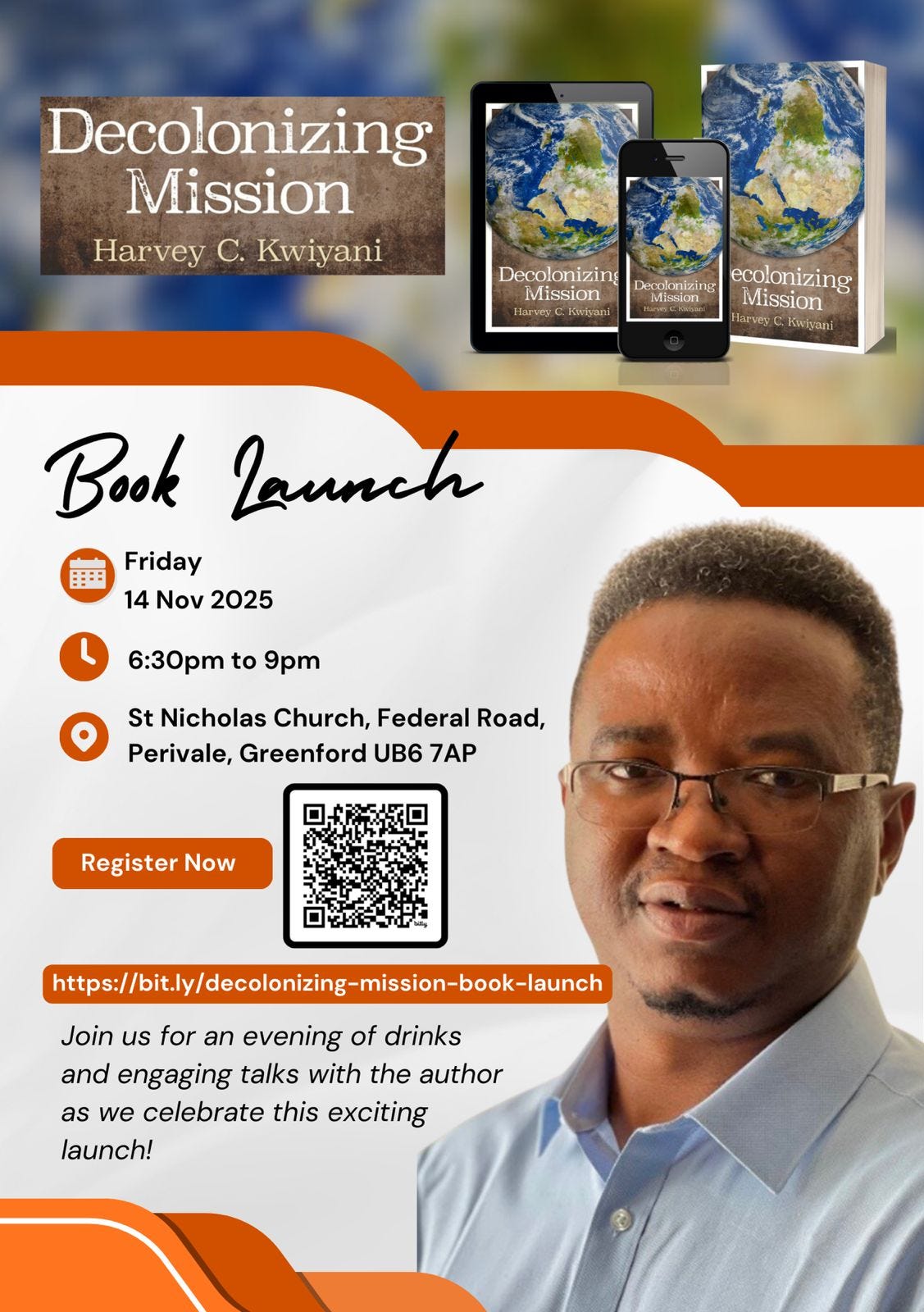
We are thrilled to continue the Decolonising Mission conversation in London on 14 November 2025, with an evening of discussion around Decolonizing Mission at St Nicholas Church, Federal Rd, Perivale, Greenford, UB6 7AP starting at 6:30pm. This gathering will bring together leaders from churches, mission agencies, and academic institutions to reflect on what decolonizing mission means in their contexts. Together, we will explore how the gospel can be shared in Spirit-led, mutually enriching, and globally interconnected ways.
Here is the registration link: https://www.eventbrite.co.uk/e/book-launch-decolonising-mission-tickets-1710364770069.
Everyone is warmly invited to join us and be part of this important conversation.
1. A Thought I Can’t Shake Off
We are coming to the end of Black History Month here in the UK. And I have done a lot of thinking this month because, of course, I am hearing back from a lot of people about Decolonizing Mission. With all this happening, I listened around the world of UK mission agencies to see if “race” or “black history” in their discourses and, no surprise at all, I did not find signs of any awareness. Mission happens well “colour-blind” world though it shouldn’t.
And I thought, many of us use these four weeks to remember stories often silenced: the endangered histories of black people around the world — Africans in the motherland but also millions of them in the Diaspora in the Americas, the West Indies, and elsewhere in the world. But remembrance alone is not enough. If we take our witness seriously, this month must also be a time of truth-telling, reflection, and action. Part of the truth that we need to wrestle with is the fact that the rise of racism in history and the spread of Christian mission are deeply intertwined. From the 15th century onwards, as European empires expanded across Africa, the Americas, and Asia, they needed moral and theological justification for conquest. Papal decrees such as Dum Diversas (1452) and Inter Caetera (1493) declared that Christian rulers could claim lands and subjugate peoples considered “heathen.” In this context, the Christian faith was often presented as a civilising force — but one deeply entangled with European superiority and racial hierarchies.
Racism is not an accident of history. It is, to a great extent, baptised into some Christian imaginations. For centuries now, Christian theology itself has been made to serve empire. Africans, Indigenous peoples, and enslaved communities were branded as cursed, primitive, or childlike—their oppression sanctified in the name of salvation. Mission was, more often than not, a weapon of domination, not a movement of making disciples for Christ. Even those who denounced slavery often left its poison untouched—the racial hierarchies that shaped their theology, their mission, and their sense of who bore the image of God.
The consequences of this are not merely historical. Theologies, liturgies, and mission practices forged in the crucible of empire continue to shape the Church’s imagination and its global witness. Too often, Western forms of Christianity remain the unspoken standard, marginalising voices from the Global South and perpetuating assumptions of cultural and spiritual superiority.
By the 18th and 19th centuries, mission societies operated as cultural arms of empire. Churches promoted European dress, languages, education, and governance alongside the gospel. The “three Cs” — Christianity, Commerce, and Civilisation — were the slogan of colonial progress. Indigenous spirituality was dismissed, and local leaders were often sidelined.
In effect, mission helped normalise racial hierarchies, subtly teaching that whiteness was closer to God and blackness needed correction.
Yet history is not only a record of complicity. From the very beginning, colonised and enslaved peoples found ways to reclaim the gospel as a message of liberation. African Independent Churches, the African Methodist Episcopal Church, and other Black Christian movements interpreted Christianity as a source of dignity, resistance, and hope. They insisted that the Spirit speaks in African idioms and that the gospel belongs to all peoples equally. Mission, in these contexts, became an act of liberation rather than domination.
Today, scholarship in World Christianity and postcolonial theology is increasingly clear: racism is not incidental to the history of mission; it was often structural. The task for the Church is to confront this history honestly. This requires not only remembering abuses but also listening to the voices of those previously marginalised and recognising their contribution to Christian thought and practice. Figures such as Samuel Ajayi Crowther, the first African Anglican bishop, or Amanda Berry Smith, a Black American evangelist, remind us that the gospel has never been the possession of any single culture.
The global shift of Christianity’s centre of gravity to the south is itself a sign of God’s Spirit at work, undoing old hierarchies and pointing toward a more just, intercultural witness. To participate faithfully in this mission, the Church must reimagine mission as a practice of solidarity, justice, and reconciliation. This means dismantling systems of power that exclude, creating spaces for shared leadership, and nurturing intercultural communities that embody the Kingdom’s promise.
To follow Christ faithfully today requires more than critique; it demands radical decolonisation. We must interrogate the ways in which our mission practices, our language, and even our ecclesial structures continue to reproduce patterns of domination. True discipleship calls for listening to those long silenced, learning from those at the margins, and allowing God’s Spirit to lead the Church into forms of witness that are humble, liberating, and polycentric—rooted in the gospel, not empire. Christian mission today cannot be separated from the work of anti-racism. To proclaim reconciliation while ignoring historical and ongoing injustices is to misrepresent the gospel. Faithful mission begins with self-examination, repentance, and humility. It continues by building relationships of mutuality, listening across difference, and advocating for structural change.
As the month comes to an end, don’t let reflection stop at remembrance. Engage in truth-telling, listen deeply, and act courageously. Commit to practices that make mission anti-racist, intercultural, and faithful to the gospel of Christ. Because the Church cannot simply speak reconciliation — it must become the reconciliation it proclaims.
It's no better on this side of the pond.