

Rest in peace, Jason.
First, as a Black academic working in the UK, let me say that I have found the circumstances surrounding Jason Arday's death profoundly difficult. My heart goes out to his family, friends, colleagues, and especially his children as they grieve this unimaginable loss. Like many others, I continue to lament the continued senseless shedding of Black blood and the immense burdens that Black people continue to carry in public life in the UK. May our children inherit a better world—one marked by greater truth, justice, mercy, and humanity than the one we have known.
What happens when mutuality is missing?
For the past few weeks, I have been reflecting on partnership, hospitality, and mutuality in preparation for the Acts 11 Project Mission and Migration Conference. The response has been encouraging. It seems many of us recognise that something has shifted in the Church. We know that Christianity has become a genuinely global faith, and we know that migration is transforming our churches. Yet many of us also sense that our relationships have not caught up with these realities. Many are wondering what is at stake for us all if we cannot get this one right.
Before I get to discuss that, in the course of teaching a Multicultural Kingdom class a few months ago, I stumbled upon a truth that has stayed with me since then.
Our structures are our theologies embodied. They reveal what our communities truly believe about God, the Church, authority, and one another. But our theologies are never developed in a vacuum; they are always interpreted, articulated, and institutionalised within particular social and historical contexts where power is at work. That is why questions of mutuality are never merely organisational. They are profoundly theological. If our structures cannot handle true mutuality, they proclaim a theology that no amount of rhetoric about partnership can conceal.
What actually happens when mutuality is missing?
Not in theory, but in practice.
What kind of Church do we become when we speak the language of partnership without sharing authority? What happens when we welcome people warmly but never allow them to shape our common life?
The answer is that partnership slowly becomes something else.
i. Partnership becomes dependency.
Partnership becomes dependency whenever one side consistently provides the funding, sets the agenda, defines success, and evaluates the outcomes. What is presented as partnership gradually becomes a relationship of unequal power, where one side dreams while the other delivers, one speaks while the other reports. Such arrangements may be efficient and even produce impressive results, but they fall short of the New Testament vision of the Body of Christ, in which every member contributes, every gift is valued, and authority is exercised in mutual dependence. Dependency may sustain programmes, but it does not cultivate genuine partnership or mutuality.
ii. Hospitality becomes paternalism.
Hospitality becomes paternalism when welcome is extended without a willingness to share power. Churches and organisations may genuinely celebrate diversity, create space for participation, and make people from different cultures feel at home, yet quietly retain control over the decisions that matter most. Leadership, budgets, vision, and theological direction remain in the hands of the traditional hosts, while newcomers are expected to contribute within boundaries set by others. Hospitality says, "There is a place for you." Mutuality says, "Help us discern where God is leading us together." The difference is profound. Hospitality without shared authority risks preserving unequal relationships beneath the language of inclusion.
iii. Diversity becomes decoration.
Diversity becomes decoration when it is celebrated visibly but not embodied structurally. Many churches proudly describe themselves as multicultural. Their worship reflects different cultures, their websites display diverse faces, and their conferences feature international speakers. Yet, when it comes to leadership (it is always fascinating to look at church leadership boards or websites), strategic decision-making, and theological direction, the same people continue to hold authority, the same assumptions continue to shape ministry, and the same voices continue to define what faithfulness looks like. Representation matters, but representation without influence is little more than symbolic inclusion. Tokenism. It creates the appearance of change while quietly preserving the existing distribution of power.
iv. The Church becomes theologically poorer.
The Church becomes theologically poorer whenever one part of the Body assumes it has little to learn from another. As I said last week, more than fifty years ago, John Mbiti posed a question to Western Christians that still demands an answer: “We know you theologically. The question is, do you know us theologically?” That challenge continues to hang over much of global Christianity. Mutuality requires more than exchanging personnel or sharing resources; it requires reciprocal theological learning. African Christians have gifts the wider Church needs. Asian Christians have gifts the wider Church needs. Latin American Christians have gifts the wider Church needs. European Christians have gifts the wider Church needs. Mutuality is not about replacing one theological centre with another, but recognising that no single part of the Body of Christ possesses everything the whole Body needs. Only as we learn from one another can the Church grow into the fullness of Christ.
v. Young Christians notice.
Perhaps one of the greatest costs of fake mutuality is the loss of credibility, especially among younger Christians. They hear the Church speak about justice, inclusion, diversity, and partnership, but they also observe who actually holds power. They notice whose ideas shape the future, whose voices carry weight in moments of decision, and who is invited not only to the platform but also into the boardroom. They quickly recognise the gap between our rhetoric and our reality. When churches celebrate diversity without sharing authority, younger generations are often the first to see the inconsistency, and many find it difficult to believe a message of reconciliation that is not fully embodied in the life of the Church.
Fake mutuality is inclusion without influence.
Fake mutuality is inclusion without influence, and I have become convinced that this is one of the defining challenges facing the Church today. It is entirely possible to include people without ever allowing them to shape us, to celebrate diversity while preserving inherited patterns of power, and to invite others to the table while quietly deciding the menu in advance. That is not mutuality. Genuine mutuality begins when we become willing to be changed by one another. It is expressed in shared leadership, reciprocal learning, collaborative authority, and a recognition that every part of the Body of Christ is not merely present but indispensable. The Church has become irreversibly global; the question now is whether our structures, institutions, and patterns of leadership are willing to become global as well.
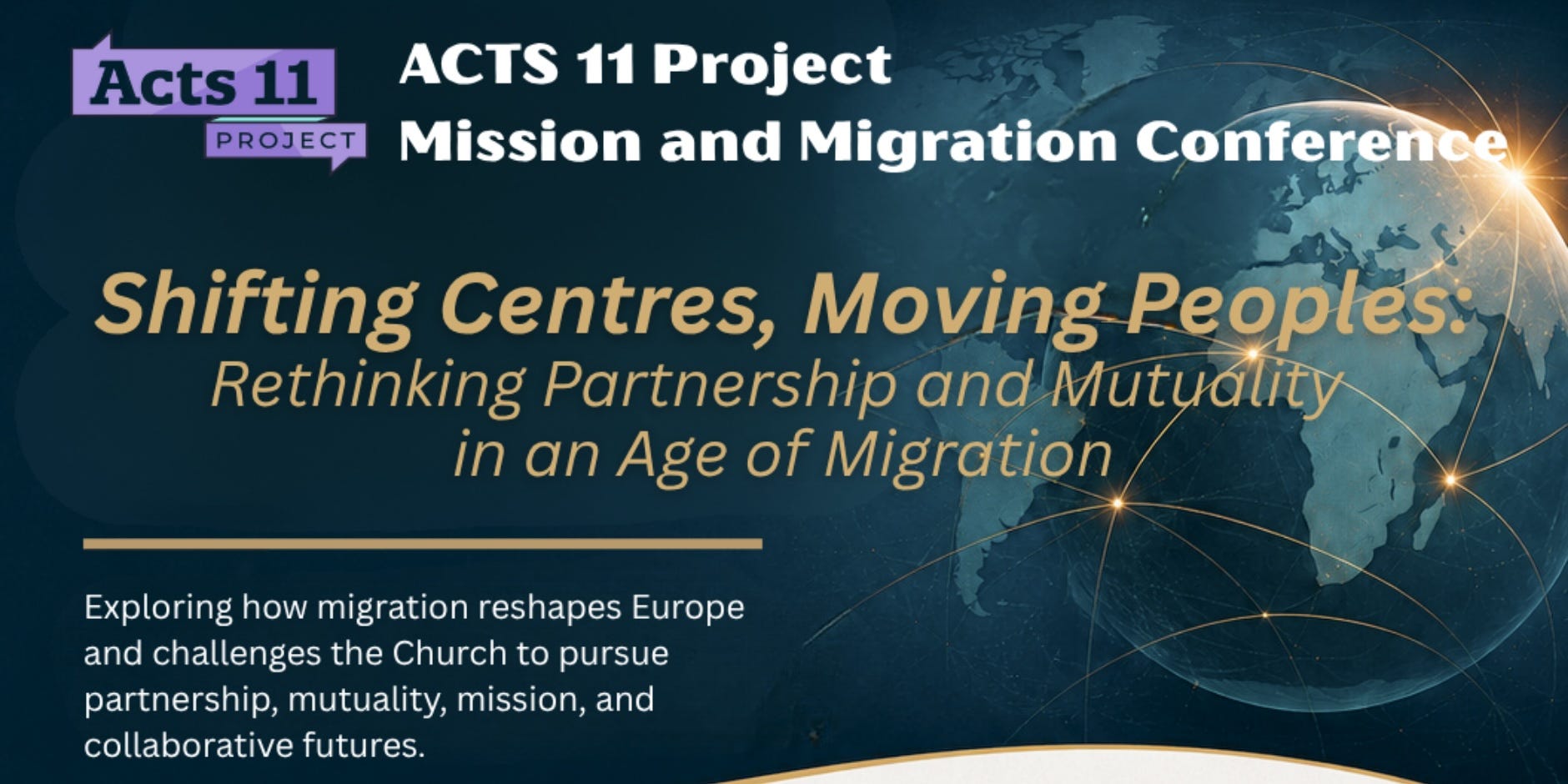
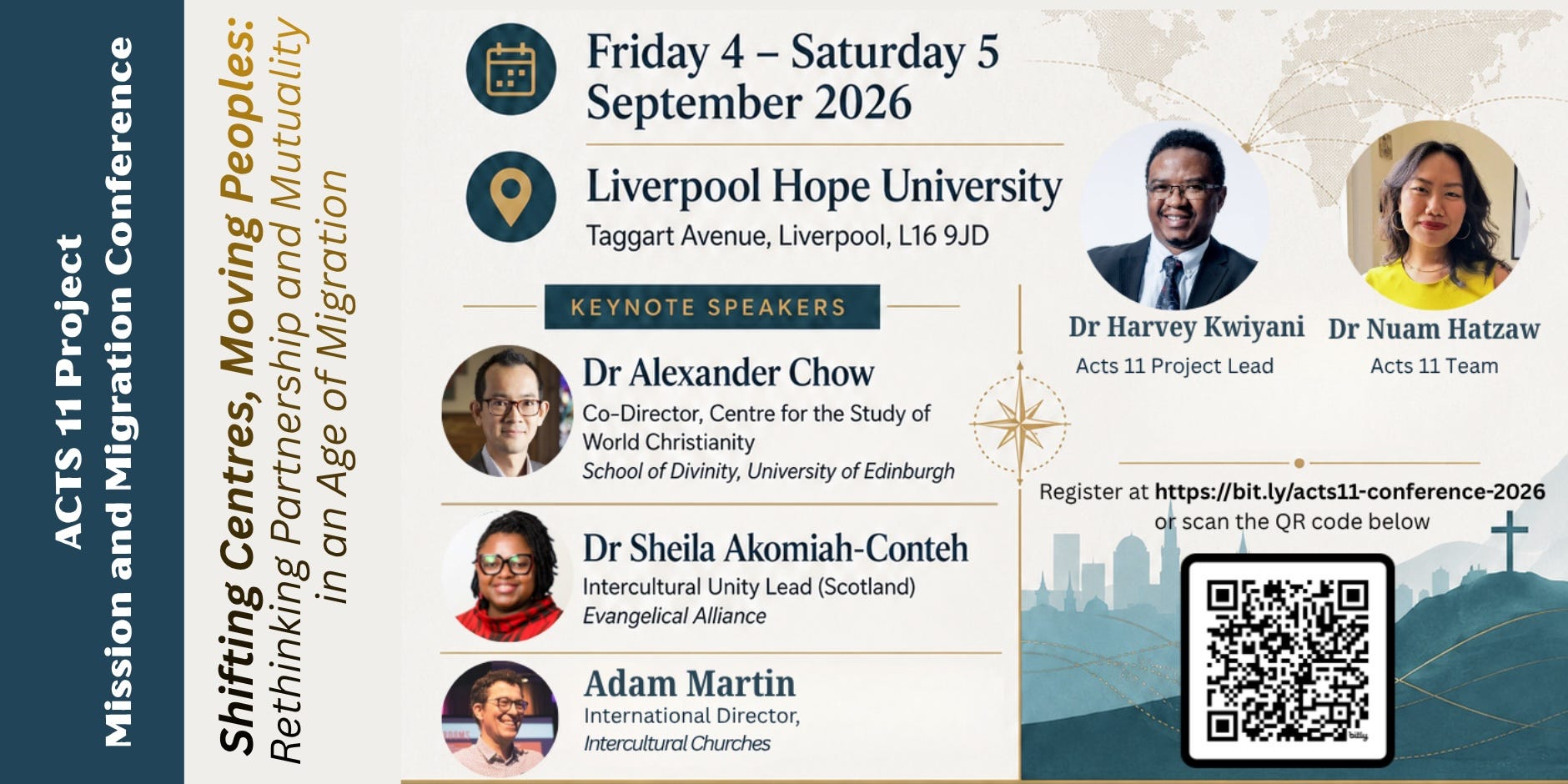
That is one of the central questions we will be exploring together at the Acts 11 Project Mission and Migration Conference in Liverpool on 4–5 September.
Not because we have all the answers. But because these conversations can no longer wait.
If partnership is to become more than a slogan, we must learn what genuine mutuality looks like—and what it costs.
I hope you’ll join us. Register here: https://www.eventbrite.co.uk/e/acts-11-project-mission-and-migration-conference-tickets-1991934834712.
Hi Harvey, I'm Mark Stevenson, I'm not sure if you'll remember me. A few years ago we had a zoom call that I really enjoyed. I wrote my doctorate on intercultural mutuality in missions. I have so appreciated your continued work and leadership in this area, and the important challenges you raise.
I would absolutely love to join the upcoming conference on "Shifting Centres, Moving Peoples." However, that weekend I will not be in a place with adequate internet service. So I'm wondering, will the conference be recorded? I know it will be streamed live, but hope that I can listen to the recordings a week or two after the conference takes place.
Blessings,
Mark
I hope you are right that younger people will spot the fake mutuality, but I fear we may be training them to accept it. I'm preparing to run a series for our church kids on the worldwide church. As part of that, I've been searching for a song we can use. We're limited to videos as we don't have any musicians, and I've found plenty that have lyrics talking about being all part of one family around the world and all equal in God's sight. But in every single case, the lyrics are set to a video portraying light skinned western kids leading with black and Asian kids acting as the 'backing group'. If kids 'praise' videos aimed at pre-school and primary kids are sending out the message that 'yes, we're all equal but white westerners take the lead', that is surely going to have a negative impact on the next generation.